When and why did we start making soap and pottery ? - The desire to create our own soap came from a trip in 2003 to Provence in France. On a warm October morning we ventured into the town of Vaison La Romaine to see their market. We were amazed at the variety of stalls selling everything from fabric to food. We stopped at one stall that sold soap. Not just one or two varieties but dozens of different types were spread out in front of us. Types that we had never seen before such as Herbes de Provence. Lavender flowers, Herbs and Spices could be seen dotted throughout the bar. This was the inspiration for our soaps and bath products. After making soap for about 12 years I decided to add some soap dishes to the line up but had a hard time in finding a type that I really wanted, so decided to give hand building dishes a try. After making a few dishes I was hooked and had to take a 5 night pottery class. After the first night I was so hooked on pottery that I had to stop myself from running down to the pottery store the next day to buy a wheel...I managed to last 3 weeks. pottery is now a major part of our business and I love to name the pieces I create after local areas in Southwest Nova Scotia. I am so grateful to the local people here for really supporting both businesses and I just love it when a customer comes to market and asks "Is that the Mavillette Beach Mug?"
Where are we located? - We are now in Weymouth North, Nova Scotia. We started our business in Kingston, Ontario and were offered the chance to move to the ocean. We just couldn't say no. We will still be called The Kingston Soap Company and will offer our regular line up of soap and bath products. If you are down east and would like to stop by and see us and our studio, drop us a line!
Do we have a store? - We do not have a physical brick and mortar store but I do have a pottery studio. If you are interested in stopping by, it is best to call to arrange a time. We sell mainly online and at a few markets. By not having a store we can visit various shows and markets more and also keep our pricing fairer for our customers. Our pottery classes are run from my studio in Weymouth North.
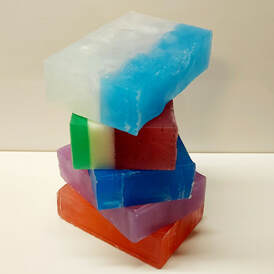
What do you specialize in ? - Many of our soaps are Castile soaps. This means that they are made using only olive oil. Pure olive oil soaps are highly moisturizing, low lathering and incredibly gentle on the skin. We have also added a line of bright, fun glycerin soaps to the lineup and they create more lather than the olive oil soaps. Finally, we also make soaps that contain a blend of olive oil and coconut oil. These soaps have a higher lather than the olive oil soaps and are still considered natural soaps.
Do you provide free shipping? - Unfortunately, the shipping costs have risen too high to continue to provide free shipping. If anything should change and costs decrease we will definitely review this.
Do you offer international shipping? - Sadly we do not. We did send internationally but the shipping times have increased so much that our products may suffer by the time they finally arrive. It was a hard decision to make, but we feel waiting over 3 months for our products is not a reasonable amount of time to wait. We will keep an eye on this situation and if we feel that the timing has improved we will revisit this decision.
When are items shipped ? - We usually start working on the order the same day it comes in. In many cases you will receive a shipping notification within a few hours of the order being received and at most it will take two business days to be shipped out. If it is longer than that we will contact you to advise as we may be away at a show or an occasional vacation week etc. Orders are shipped by Canada Post and should arrive to you between 1-7 days after being mailed depending on where you are located and also the time of year can sometimes delay postage.
Why can't your ingredient list be in a common language? - Once a product is formulated, we send the ingredient listing off to Health Canada so it can be logged in their system. It is law that the ingredient listing used on the label is only in INCI terms. INCI stand for International Nomenclature of Cosmetic Ingredients. For the olive oil soap the actual ingredients are Olive Oil, Water and Lye but in INCI terms these ingredients are Olea Europaea (Olive) Fruit Oil, Aqua, Sodium Hydroxide.
Where do we source our ingredients ? - We work with primarily 3 companies to purchase all of our goods. We searched high and low to find these companies as they provide super high quality ingredients to make our products and really do stand behind their products. Our suppliers of fragrance oils are free from parabens and also phthalate free. The essential oils are 100% pure and have not been adulterated or diluted. As we have limited our suppliers to a few, we can buy high quality ingredients in bulk from them and reduce our costs and pass along the savings to you when possible.
What are some core values of The Kingston Soap Company/Dhe'n Dor Pottery ? - We pride ourselves on our super high levels of customer care. We will and do go above and beyond for our customers. We also listen to our customer base and have evolved thanks to them. When a new product is suggested we take the request seriously and look into it to see if it is possible. Our customers are what keep us going after all. We are also very concerned about the environment and how our products will interact with it. We refuse to use any essential oil that is obtained by dubious means and will use a fragrance oil to create the aroma instead. A perfect example of this is Sandalwood oil. The Sandal tree is being harvested by clear cutting forests and the essential oil is now so valuable that it is often traded on the black market. We use a fragrance oil in protest to this. While our purchasing power is just a small drop in the bucket, we will do what we can and hope that other businesses also follow suit.
Where are we located? - We are now in Weymouth North, Nova Scotia. We started our business in Kingston, Ontario and were offered the chance to move to the ocean. We just couldn't say no. We will still be called The Kingston Soap Company and will offer our regular line up of soap and bath products. If you are down east and would like to stop by and see us and our studio, drop us a line!
Do we have a store? - We do not have a physical brick and mortar store but I do have a pottery studio. If you are interested in stopping by, it is best to call to arrange a time. We sell mainly online and at a few markets. By not having a store we can visit various shows and markets more and also keep our pricing fairer for our customers. Our pottery classes are run from my studio in Weymouth North.
What do you specialize in ? - Many of our soaps are Castile soaps. This means that they are made using only olive oil. Pure olive oil soaps are highly moisturizing, low lathering and incredibly gentle on the skin. We have also added a line of bright, fun glycerin soaps to the lineup and they create more lather than the olive oil soaps. Finally, we also make soaps that contain a blend of olive oil and coconut oil. These soaps have a higher lather than the olive oil soaps and are still considered natural soaps.
Do you provide free shipping? - Unfortunately, the shipping costs have risen too high to continue to provide free shipping. If anything should change and costs decrease we will definitely review this.
Do you offer international shipping? - Sadly we do not. We did send internationally but the shipping times have increased so much that our products may suffer by the time they finally arrive. It was a hard decision to make, but we feel waiting over 3 months for our products is not a reasonable amount of time to wait. We will keep an eye on this situation and if we feel that the timing has improved we will revisit this decision.
When are items shipped ? - We usually start working on the order the same day it comes in. In many cases you will receive a shipping notification within a few hours of the order being received and at most it will take two business days to be shipped out. If it is longer than that we will contact you to advise as we may be away at a show or an occasional vacation week etc. Orders are shipped by Canada Post and should arrive to you between 1-7 days after being mailed depending on where you are located and also the time of year can sometimes delay postage.
Why can't your ingredient list be in a common language? - Once a product is formulated, we send the ingredient listing off to Health Canada so it can be logged in their system. It is law that the ingredient listing used on the label is only in INCI terms. INCI stand for International Nomenclature of Cosmetic Ingredients. For the olive oil soap the actual ingredients are Olive Oil, Water and Lye but in INCI terms these ingredients are Olea Europaea (Olive) Fruit Oil, Aqua, Sodium Hydroxide.
Where do we source our ingredients ? - We work with primarily 3 companies to purchase all of our goods. We searched high and low to find these companies as they provide super high quality ingredients to make our products and really do stand behind their products. Our suppliers of fragrance oils are free from parabens and also phthalate free. The essential oils are 100% pure and have not been adulterated or diluted. As we have limited our suppliers to a few, we can buy high quality ingredients in bulk from them and reduce our costs and pass along the savings to you when possible.
What are some core values of The Kingston Soap Company/Dhe'n Dor Pottery ? - We pride ourselves on our super high levels of customer care. We will and do go above and beyond for our customers. We also listen to our customer base and have evolved thanks to them. When a new product is suggested we take the request seriously and look into it to see if it is possible. Our customers are what keep us going after all. We are also very concerned about the environment and how our products will interact with it. We refuse to use any essential oil that is obtained by dubious means and will use a fragrance oil to create the aroma instead. A perfect example of this is Sandalwood oil. The Sandal tree is being harvested by clear cutting forests and the essential oil is now so valuable that it is often traded on the black market. We use a fragrance oil in protest to this. While our purchasing power is just a small drop in the bucket, we will do what we can and hope that other businesses also follow suit.